

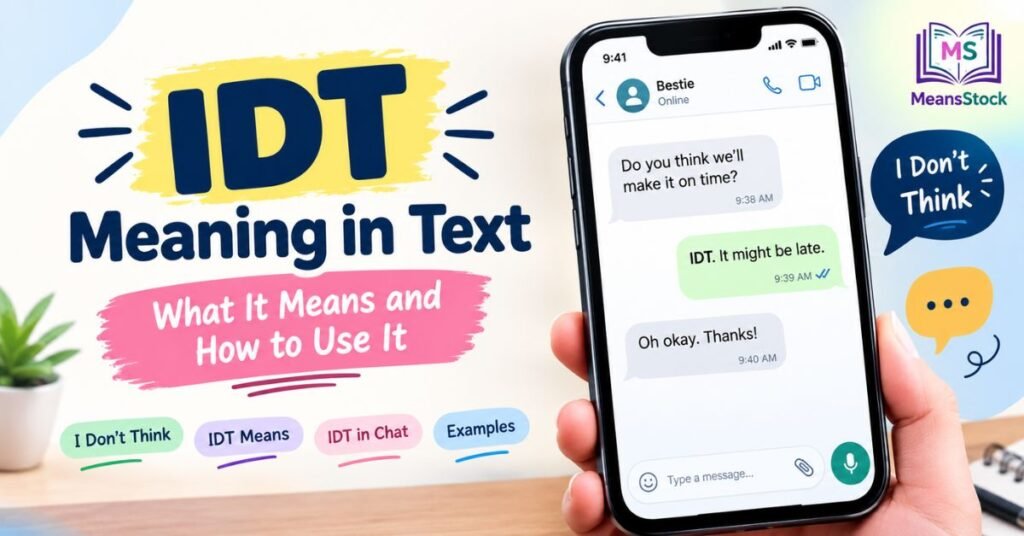
If someone sends you “IDT” in a text message, you might wonder what they mean. This abbreviation is common in casual online conversations, where people prefer short and quick messages. The most common IDT meaning in text is “I don’t think.” People use it to express doubt, share an opinion, or respond when they are unsure about something. However, its exact meaning can depend on the conversation and the sender’s intention.
In this guide, you’ll learn what IDT means, how people use it in chats, and how to understand it through simple examples. You’ll also discover when to use this abbreviation and how it differs from similar texting slang.
What Does IDT Meaning in Text?
IDT stands for “I don’t think.” It is an informal abbreviation used in text messages, social media conversations, and online chats.
People usually type IDT when they want to express uncertainty or give a negative opinion without writing a complete sentence.
For example:
- “IDT he’ll come today.” — I don’t think he’ll come today.
- “IDT that’s a good idea.” — I don’t think that’s a good idea.
- “IDT so.” — I don’t think so.
In these examples, IDT makes the message shorter while keeping its original meaning.
The abbreviation is informal, so it works best in conversations with friends, family, or people you know well. For professional emails or formal messages, writing the complete phrase is usually clearer.
Quick Answer: IDT Meaning
IDT = I Don’t Think
IDT is an informal abbreviation that expresses doubt, uncertainty, or mild disagreement.
Example
“IDT we have enough time.”
Meaning: I don’t think we have enough time.
What Does IDT Stand For?
IDT comes from the first letters of three words:
| Letter | Word |
|---|---|
| I | I |
| D | Don’t |
| T | Think |
The abbreviation usually introduces an opinion or a statement about something the sender considers unlikely.
For example, “IDT she knows” means “I don’t think she knows.”
Unlike IDK, which means “I don’t know,” IDT expresses a belief or judgment. The sender may have an opinion but lacks complete certainty.
How Is IDT Used in Text Conversations?
The IDT meaning in chat becomes clearer when you look at the situation. People generally use it in three ways.
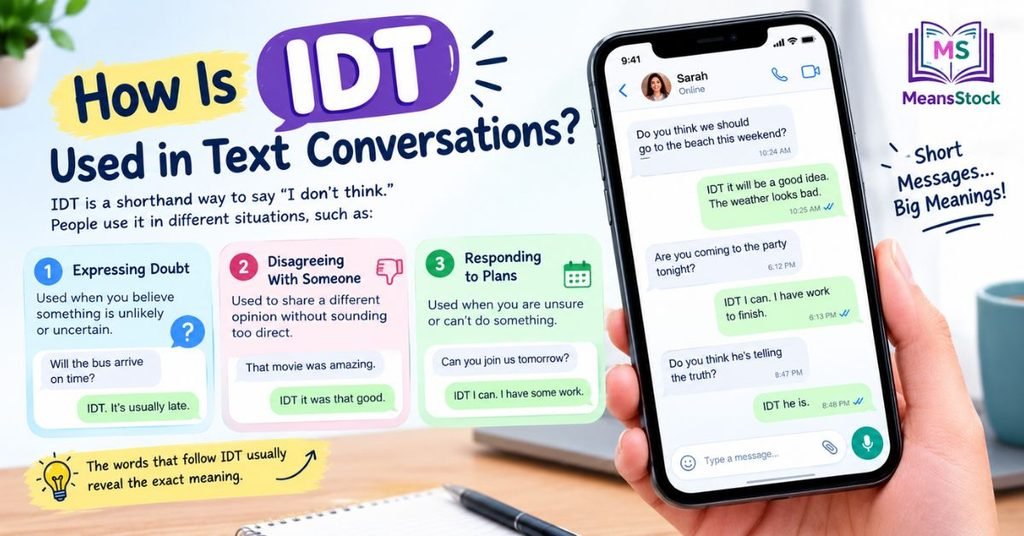
1. Expressing Doubt
Someone may use IDT when they believe something probably will not happen.
Example:
Friend: “Will the bus arrive on time?”
You: “IDT. It’s usually late.”
Here, the sender doubts that the bus will arrive on time.
2. Disagreeing With Someone
IDT can introduce a different opinion without making the response sound too direct.
Example:
Friend: “That movie was amazing.”
You: “IDT it was that good.”
The sender disagrees with the opinion but does not make an aggressive statement.
3. Responding to Plans
People also use IDT when they are unsure whether they can attend an event or complete something.
Example:
Friend: “Can you join us tomorrow?”
You: “IDT I can. I have some work.”
The response suggests that joining may not be possible. It also gives a reason for the uncertainty.
IDT Meaning in Chat: Real-Life Examples
These conversations show how IDT fits into everyday messaging.
Will you finish the assignment tonight?
Friend
IDT. I still have two chapters left.
You
Do you think he is telling the truth?
Friend
IDT he is.
You
Should we order pizza?
Friend
IDT that’s a bad idea!
You
In the first conversation, IDT expresses doubt about finishing the assignment. In the second, it shows disbelief. In the third, the sender uses it to introduce an opinion.
The same abbreviation can serve different purposes. The words that follow it usually reveal the intended meaning.
Is IDT Rude or Disrespectful?
IDT meaning is not inherently rude. It is a casual way to express an opinion, but the surrounding words can change how the message feels.
For example:
- Friendly: “IDT so, but let’s check.”
- Neutral: “IDT that’s correct.”
- Potentially dismissive: “IDT anyone cares.”
A short reply like “IDT” may also seem abrupt if the other person expects an explanation.
If you want to sound polite, add a reason or a softer phrase. For example, “IDT that will work because we don’t have enough time” explains your opinion clearly.
IDT vs. IDK vs. IDTS
IDT, IDK, and IDTS look similar, but they communicate different ideas. Understanding the difference helps you interpret messages correctly.
| Abbreviation | Full form | Meaning |
|---|---|---|
| IDT | I Don’t Think | Expressing an opinion or doubt |
| IDK | I Don’t Know | Showing a lack of knowledge |
| IDTS | I Don’t Think So | Expressing doubt or a likely negative answer |
Consider this example:
Friend: “Do you think the shop is open?”
- “IDT” means you believe it probably isn’t open.
- “IDK” means you don’t know whether it’s open.
- “IDTS” means you don’t think it is open.
IDTS is especially useful as a complete short response. IDT often introduces a longer thought, although people sometimes use it alone when the meaning is obvious.
Does IDT Have Other Meanings?
In ordinary texting, the most common IDT meaning is “I don’t think.” However, abbreviations can have different meanings in specific communities.
Some people may use IDT to mean “I didn’t think” or “I don’t talk.” These interpretations are less common and depend on the surrounding sentence.
For instance, “IDT you were serious” might mean “I didn’t think you were serious.” However, the sender’s intended meaning is not always clear from the abbreviation alone.
In professional or technical settings, IDT may also refer to an organization-specific term or technical abbreviation. These meanings should not automatically be applied to a casual text message.
The best approach: Read the complete sentence and consider the conversation before deciding what IDT means.
How to Reply When Someone Texts IDT
Your response should match the sender’s message and the situation.
Here are some natural replies:
| Their message | Possible reply |
|---|---|
| “IDT he’ll come.” | “Why do you think that?” |
| “IDT so.” | “Okay, let’s see.” |
| “IDT we should go.” | “Is there a reason?” |
| “IDT I can make it.” | “No problem, maybe next time.” |
If you are unsure what the sender means, asking a simple question is better than making assumptions.
For example, “Do you mean you don’t think so?” can clear up confusion without making the conversation awkward.
When Should You Use IDT?
IDT works best when you are chatting informally with people who understand texting abbreviations.
Use it when:
- You want to express a quick opinion.
- You are responding to a suggestion.
- You want to show uncertainty.
- You are having a casual conversation with friends.
Avoid relying on IDT in formal emails, academic writing, or important professional discussions. In those situations, writing “I don’t think” or “I am not certain” makes your meaning clearer.
Remember that not everyone recognizes the same abbreviations. A complete sentence can prevent misunderstandings, especially when the message involves an important decision.
Frequently Asked Questions
What does IDT meaning in text?
IDT usually stands for “I don’t think.” People use it to express doubt, uncertainty, or disagreement in casual messages.
What does IDT mean in chat?
The IDT meaning in chat is generally “I don’t think.” It helps people share opinions and respond quickly during online conversations.
What does IDT meaning from a girl or guy?
The abbreviation has the same basic meaning regardless of who sends it. The sender’s tone and the surrounding conversation determine the intended message.
Does IDT mean I don’t think so?
IDT can communicate “I don’t think so” when the context makes the rest of the sentence clear. IDTS is the more explicit abbreviation for “I don’t think so.”
Is IDT the same as IDK?
No. IDT meaning “I don’t think,” while IDK means “I don’t know.” One expresses an opinion; the other expresses a lack of knowledge.
Can I use IDT in professional messages?
You can, but it is usually better to write the complete phrase. “I don’t think this approach will work” sounds clearer in a professional discussion.
Conclusion
Understanding the IDT meaning in text makes casual online conversations easier to follow. The abbreviation usually stands for “I don’t think” and helps people express doubt, uncertainty, or disagreement without typing a full sentence.
Its meaning becomes clearer when you consider the complete message, the relationship between the people chatting, and the situation. While IDT works well in informal conversations, using complete sentences is often better for professional communication.
The next time someone sends you IDT, look at the words around it before deciding what they mean. A little context can make even a short abbreviation easy to understand.
